Tuesday, August 28, 2007

Jam, Jelly, Marmalade and Preserves, etc.

According to thenibble.com information:

"The difference among these spreads is largely one of consistency, and for the first three, standards are established by the Food and Drug Administration so consumers will know what they’re buying.

Jelly is a clear, bright product. It is generally made by cooking fruit juice and sugar with pectin as a jelling agent and lemon juice as an acid to maintain a consistent texture. Jelly is firm and will hold its shape (it “shakes”). Generally, jelly contains no pieces of fruit, although specialty jellies, like pepper jelly, may include pieces of jalapeño or other pepper.

Jam
is made from crushed or chopped fruit cooked with sugar, and often pectin and lemon juice. Jam can be a purée of fruit or have a soft pulp, but it does not contain chunks of fruit.

Preserves
are fruit cooked with sugar to the point where large chunks of fruit or whole fruit, such as berries, are suspended in a syrup base. The texture of preserves is not smooth like jelly or jam.

Marmalade is a soft jelly, often citrus-based, that includes both the flesh and peel of the fruit suspended throughout the jelly base. The bitterness of the peel offsets the sweetness of the jelly.

Conserve is a mixture of more than one fruit, often with added nuts and raisins, that is cooked until it becomes thick. It is used as a spread for breads, pastries and meats, and in the latter use is closest to chutney.

Chutney
is a spiced condiment of Indian origin (chatni is the Hindi word for strongly spiced) made of fruit or vegetables. It is typically served as an accompaniment to food, not as a spread. The spice level can range from mild to hot, and the consistency from a fine relish to a preserve or conserve. Fruit chutney consists of chopped fruit, vinegar, spices and sugar cooked into a chunky sweet-tart-spicy mix: according to one explanation, it “blurs the Western distinction between preserves and pickles.”

Fruit Butter
, such as apple butter or prune butter, is fruit purée or pulp combined with sugar, lemon juice and spices, slowly cooked down to a smooth consistency. The “butter” refers to its spreadability: there is no actual butter in the product.

Fruit Curd is a creamy spread made with sugar, eggs and butter, generally flavored with citrus juice and zest.

Fruit Spread is generally a reduced-calorie product made with fruit juice concentrate and low-calorie sweeteners replacing all or part of the sugar."

Labels:

Monday, August 27, 2007

weird food from around the world

So lately I have acquired the taste for Natto, this makes me contemplate on the "weird food" around the world. Some of these acquired taste things I have tried already, and other I have heard about and want to try. (and this will be a constantly growing list)..


also found another interesting blogsite of Japanese/Chinese food here.

The weird foods run the gamut from insects and arachnids of various sorts through the American turducken all the way to dried Philippine lizard. There are many bizarre stops along the way.

  • American turducken
  • Pearl milk tea
  • alcohol - cocktail, wine, beer, wine cooler I have had before though.
  • Then here’s seagull wine. The Eskimos create it by putting a seagull in a bottle and letting it ferment in the sun.
  • Natto - JP
  • Takoyaki - JP
  • Durian - South East Asia
  • "Stinky Tofu" - CN
  • Chutney - India
  • pig internals / interstine - Canton, CN
  • legendary monkey brain - remote CN
  • fried piggy (like the one in the picture here!) - CN
  • 1,000 year old egg - CN
  • Kumis - Mongolian fermented horse mare milk
  • fried insects - Thailand
  • fried silk worm - Thai
  • skewered scorpions
  • Shepherd's pie - Wiki & Cumberland Pie - England
  • Vegemite in Australia and New Zealand
  • Marmite in the UK
  • bleu cheese in France
  • raw herring - France
  • lutefisk in Norway and Sweden
  • Mämmi in Finland
  • Prairie Oyster - Alberta, Canada
  • dried frog => stew for sick children - Korea
  • camel hump => fried - BJ, CN
  • sea slugs are eaten with red pepper sauce in Seoul, Korea
  • maggot cheese from Sardinia
  • jellied blood - both Korea and China
  • Owl's soup - China
  • foire gras - France
  • (and the list goes on and on...)
I can say for certainty that for myself, I don't find Canadian, Mongolian, British, and German food particularly interesting / palatable.

Strange food listing here. and there's even a "weird food" search site. Then again, remember, "strange" is relative, it only depends on your perspective!

Labels:

Peanut Butter and Jelly sandwich

My mother is an avid fan of peanut butter, but I didn't care for it much, if anything, I'd rather eat a cream cheese and jelly bagel. That is, until recently. Last year spring time, I had the opportunity to try out this new fashion food restaurant(?)/place called the "Peanut Butter & Co." located in the heart of Greenwich village in NYC. Ever since then, I guess I also acquired the taste of it. It's ridiculous how New Yorkers would pay upwards of $5-7 for a PB&J sandwich! Though I do have to admit that the toasted marshmallow tasted awesome on my PB&J.

A little search yields further info regarding this common household children's favourite:
What is the history of the peanut butter and jelly sandwich? It seems like such an odd combination of flavors.

We don't think of good ol' PB&J as such an odd combination -- it's the classic salty-meets-sweet pairing that's found in many cuisines. Think of Chinese dishes like sweet and sour pork or American snacks like Cracker Jack. To uncover the sandwich's origins, we said those magic words "A la, peanut butter sandwiches!" and searched on "peanut butter jelly sandwich history."

According to Smuckers, no one really knows when or where this sandwich was first created. Bread and jelly have been around for millennia, but peanut butter wasn't invented until 1890. This spreadable creation was a hit at the 1904 World's Fair in St. Louis, and during the 1920s and 1930s, commercial brands of peanut butter such as Peter Pan and Skippy were introduced. Around the same time, pre-sliced bread became common in the U.S. But there's no mention of peanut butter and jelly sandwiches before the 1940s.

Food historians know that both peanut butter and jelly were part of the U.S. military's rations during World War II. This lead to the speculation that American GIs may have added jelly to the peanut butter to make it easier to eat. A few sources claim that the peanut butter and jelly sandwich itself was on military ration lists.

Food rationing on the homefront may have contributed to the combination's popularity. Meat and butter were scarce and expensive in the U.S. during WWII. Peanut butter was a cheap, readily available source of protein. No matter how it started, the PB&J was a big hit in postwar America and has been ever since.

We suspect that the sandwich is popular with children because of that salty-sweet flavor, and early on, parents may have appreciated how fast, simple, and inexpensive it was to make. The National Peanut Board reports that the average kid eats 1,500 peanut butter and jelly sandwiches before she or he graduates high school. Then there was Elvis Presley, who may have eaten that many fried peanut butter and banana sandwiches. We'll stick with jelly, thanks.

Labels:

Sunday, August 26, 2007

Value of Natto

I started eating some Natto recently, it being odor-free definitely helps one to acquire the taste.
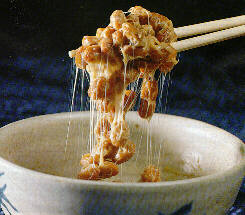
According to this article, the nutritional value of natto is immense. And I have to admit, the gooey texture makes it quite fun to eat... (hehee.. guess I am the playing with your food type after all). And another article with a nice sticky picture!

Wikipedia info here, Natto info from the Soy Info Center, and article excerpts below...

...

A unique food called natto, which is made by fermenting soy beans and has been eaten widely in Japan since the Edo period (1603-1868), is enjoying unprecedented popularity as more and more people turn to it for its health-boosting properties. It is likely to be a record year for natto sales in 2002.

Smell Puts Some People Off
Natto is produced by adding the bacillus of the same name to steamed soybeans for fermentation. It boasts a variety of health benefits, including helping fatigued people regain their vigor and preventing heart disease and high blood pressure. Some people dislike natto, however, due to its extremely sticky texture and strong odor. It was originally produced in the eastern part of Japan, so it is more popular there than in western regions. While it has a poor reputation among some foreigners in Japan, others acquire a taste for it. The smell, which is what puts off most natto detractors - both foreign and Japanese - may no longer be an issue, though, as aroma-free varieties of natto have been developed and are one of the factors behind the boom in sales.

When eating natto, the beans are first stirred vigorously with chopsticks. Many people also add mustard, soy sauce, and green onions, and the mixture is often eaten after it is poured over rice. Natto retains the nutrients that are naturally present in soybeans, and the natto bacillus used in production makes the food even healthier by providing further nutrients.

Health Benefits
Natto is even more effective than yogurt at increasing the amount of health-promoting bifidus bacilli in the large intestine. It also contains linoleic acid, which may help prevent cancer; arginine, which has been shown to boost stamina; vitamin B2, which helps the body fight fatigue; and vitamin E, a powerful antioxidant that may help reduce the effects of aging. And in 1988 it was confirmed that natto contains an enzyme called nattokinase that reduces blood clots. Such discoveries have caused the popularity of natto to soar.

Notwithstanding its nutritional value, though, the pungency and stickiness of natto have acted as a brake on consumption. But despite the widespread impression in Japan that non-Japanese cannot eat natto, a TV station reported in a special feature on the food that a natural-foods store in New York has begun selling natto. The store notes that while the first customers were Japanese families living in the area, recently all sorts of people are buying natto. Americans purchasing natto at the store were heard to say such things as "My menstrual cramps have almost disappeared," and "I used to get angry easily, but now I don't even get irritated."

The different ways that some Americans eat natto, though, would probably surprise many Japanese. The program showed an American woman adding honey to the natto, stirring in fried sesame seeds, and spreading the mixture onto crackers.


...

--------- in reply to pekko's comment:
hey, I've learned to like my steak rare, tried Fermented HorseMare milk in Mongolia, and one day will try the fried insects in Thailand, "stinky tofu" in China, "pig internals" in Canton, and "Durian" in Taiwan... I think I am an adventurous eater...

Wiki quote: "Nattō is often considered an acquired taste and the perceived flavor of nattō can differ greatly between people; some find it tastes very strong and cheesy and may use it in small amounts to flavor rice or noodles, while others find it tastes "bland and unremarkable", requiring the addition of flavoring condiments such as mustard and soy sauce. Many non-Japanese find the taste very unpleasant, while others relish it as a delicacy. Some manufacturers produce an odorless or low-odor nattō. The split opinion about its appearance and taste might be compared to Vegemite in Australia and New Zealand, blue cheese in France, lutefisk in Norway and Sweden, Mämmi in Finland and Marmite in the UK. Even in Japan, nattō is more popular in some areas than in others. Nattō is known to be popular in the eastern Kantō region (Tokyo), but less popular in Kansai (Osaka, Kobe). About 236,000 tons of nattō are consumed in Japan each year."

Labels:

Wednesday, June 20, 2007

Cheese Blintz with Blueberry Compote

I just found this great show which I am going to schedule on my Tivo: Bay Cafe. Apparently, KRON4 has all these local shows targeting the bay area, I really like them and am going to start exploring outside of my narrow Asian scope. =)


Cheese Blintz with Blueberry Compote

Adapted from Jesse Cool�s Breakfast in Bed, published by Harper Collins

Prepared by Joey Altman

Blintz Batter

4 eggs, beaten

� cup unbleached white flour

a big pinch of salt

1 cup whole milk

3 tablespoons of melted butter

For the filling

2� cups farmer�s cheese

1 egg yolk

� cup sugar

� teaspoon ground nutmeg

� teaspoon cinnamon

� teaspoon salt

� cup blue berries

butter or vegetable oil

2 cups fresh blueberries

1/2 cup sugar

sour cream for garnish (optional)

1. In a medium size bowl, mix together the flour and salt

2. Gradually whisk in the eggs and then the milk until smooth.

3. Stir in the melted butter.

4. Lightly oil a heavy, 8-inch crepe pan, and heat it over a medium heat.

5. Pour in about 3 tablespoons of batter, and tilt the pan to spread it evenly over the bottom. Cook the crepe until it�s brown on the bottom and no longer runny on the top (don�t flip it!) Remove it to a plate with a spatula.

6. Cook the rest of the batter, oiling the pan again each time and stacking the finished crepes on top of each other, cooked side up. You�ll have about twelve.

To make the filling

1. In a medium size bowl, mix together the cheese, yolk, sugar, nutmeg, cinnamon, salt and berries.

To make compote

1. In a non-reactive sauce pan on medium heat cook the berries and the sugar together just until the sugar dissolve completely and the berries just start getting soft, approximately for 5 minutes.

To finish the blintzes

1. Place a crepe, browned side up, on a flat surface.

2. Place 2 generous tablespoons of filling in a fat line down the center.

3. Fold one side over the filling. Fold both ends in toward the center, and then roll the blintz the long way to seal.

4. Allow2 -3 blintzes per person. Freeze extra.

5. Heat a small amount of butter or vegetable oil in a large, heavy skillet over medium heat.

6. Working in batches, place the blintzes in the pan, seam side up, and cook until lightly browned, 3 to 4 minutes, turn and brown on the other side, to 4 minutes longer. If they have been frozen, brown the blintzes over low heat, covered, and turn them more often.

7. Transfer the blintzes to a plate and top them with the blueberry compote and sour cream if you like and serve immediately.

BC 04-22

Labels:

Thursday, May 24, 2007

Repurposing a Rice Cooker

It may be called a rice cooker, but don't let that stop you from using it for:

Making hot breakfasts — and keeping them hot. To make oatmeal or other hot breakfast cereals, add a little less milk or water than you would for stovetop cooking (and some chopped nuts and dried fruit if you want). The "keep warm" function is perfect for days when everyone gets up at a different time.

Steaming vegetables or making vegetable-based one-pot meals. If your machine comes with a steamer rack, use it to cook cut vegetables, tofu, potatoes, or even shrimp, fish fillets, or chicken breasts.

Making risotto without stirring. Saute onions in butter in an open rice cooker, then add 1 part Arborio rice and 4 parts liquid (such as broth and wine). Cook for about 25 minutes in an on/off cooker or use the "slow" or "porridge" cycle if your machine has one. Mix in grated cheese and herbs at the end.

Slow-cooking soups, beans, or stews. Give your rice cooker enough liquid and time and it will create long-simmered dishes without scorching or boiling over (the way slow cookers sometimes can). Try split-pea soup with ham, or put beef (that's been browned on the stove) and vegetables in the cooker with tomatoes, wine, and herbs for a hearty dinner.

Poaching fruit. A rice cooker works for healthy desserts of fruit simmered in juice, wine, or maple syrup. Or make applesauce and other fruit sauces.

=========
saw this link from a friend's blog. 3Q Kuri!

Labels:

Monday, April 30, 2007

Email thread - reflection of human dynamics

I come in to work today, and the first thing I noticed is there are over 100 emails under the thread "Important: Health Care Spending Reminder". Apparently, HR sent out the reminder to 5000+ on a particular alias, and all it took is ONE stupid individual to hit "Reply-all" and spam the entire list with a complaint of her personal account problem.

Then instead of the usual "Take me off" and "Me too!" mails, initially people were trying to be polite, and in attempt to ask people to not hit "Reply-all". But a few emails later, it deteriorated into other people who *somehow* felt it was appropriate to vent their frustration with the HCSR procedure to send their personal complaints to the entire mailing list. And shockingly, more than 4-5 people did this. They figured it only took them 30sec to type up a complaint email, but it wasted thousands of other people's email time, and generated email traffic (which btw, is not exactly FREE if you compute the cost of computer cycle time).

Amazingly, I am both annoyed and amused at how this whole thing folded out. Don't these people realize that their angry responses are not anonymous, that your boss and directors could be reading your flame mails at this time?

=============
Finally, after a series of complaints, and people trying to stop the complaints thread, and there are apparently people who have too much time on hand to *intentionally* spam the group, see one of the emails below as an attempt of a "humor" response:


TERIYAKI SALMON

2 c. soy sauce
1/2 tsp. garlic powder
2 tsp. ginger
1 1/4 c. sugar
1 1/2 c. cooking sherry
1/2 tsp. onion powder
1 c. brown sugar
8-12 salmon steaks
Combine all ingredients except salmon in a saucepan and simmer for 45
minutes. Do not boil. Make sure sugar dissolves completely. Cool.

Marinate steaks 4 hours in sauce. Barbecue steaks over hot coals until
fish flakes easily when tested with a fork. Reheat Teriyaki Sauce and
pour over each individual dish to serve with salmon steaks.


=======
At the time of the blog, the email thread is still going on, and the recipe list has grown to include lamb chops and flambe .. This is NOT an interest group mailing list!

yes, I can set up my mailbox in thread view and ignore the now 100+ msgs under it, but I *should NOT* have to! These people should exercise their maturity and self control and respect for others! I suggest all these people who are stupid enough to do this be FIRED!

Labels:

Monday, April 23, 2007

citrus mini cakes

Citrus Mini CakesCitrus Mini Cakes

These moist, bite-size treats from Linda Terrell of Palatka, Florida are melt-in-your-mouth good. "With their appealing look, they really dress up a party table," she notes. The recipe makes a big batch, so there's plenty to please a crowd.

INGREDIENTS:

  • 1 package (18-1/4 ounces) yellow cake mix
  • 1-1/4 cups water
  • 3 eggs
  • 1/3 cup vegetable oil
  • 3-1/2 cups confectioners' sugar
  • 1/2 cup orange juice
  • 1/4 cup lemon juice
  • Toasted chopped almonds


SERVINGS 36
CATEGORY Dessert
METHOD Baked
PREP 15 min.
COOK 20 min.
TOTAL 35 min
Tips & Ideas:
To freeze baked goods to enjoy later, use freezer bags or containers with tight-fitting lids, or wrap items securely in moisture-proof wrap, heavy-duty foil or freezer paper. Don't forget to label and date items before freezing.

DIRECTIONS:

In a large mixing bowl, combine cake mix, water, eggs and oil; beat on low speed for 30 seconds. Beat on medium for 2 minutes.

Fill well-greased miniature muffin cups two-thirds full. Bake at 350° for 10-12 minutes or until a toothpick inserted near the center comes out clean.

Meanwhile, in a large bowl, combine sugar and juices until smooth. Cool cakes for 2 minutes; remove from pans. Immediately dip cakes into glaze, coating well. Place top down on wire racks; sprinkle with almonds. Yield: about 6 dozen.

Labels:

Tuesday, April 10, 2007

cute cupcakes


I heard about this cupcakery place in Berkeley while at an Easter luncheon, "Love at first Bite", just the name sounds delicious, and their menu has different twist on flavoured cupcakes too, like "Lemon kiss", "First love", "pure love", etc.... very creative and apparently Yelp reviewers said that the place has very cute decorations. Next time I am in Berkeley area, I will have to give these pricey $2.50 cupcakes a try.

Also check out these dedicated cupcake blogsites: cup-cakes-take-the-cake, 52 cupcakes, girls-who-sell-cupcakes ... and recipe blogs from the owners of Citizen Cake in SF.

Golden Butter Cupcakes Recipe

Golden Butter Cupcakes

  • 2 cups all-purpose flour
  • 1 1/2 cups sugar
  • 2 1/2 tsp baking powder
  • 1 tsp salt
  • 3/4 cup butter or margarine (1-1/2 sticks) softened
  • 3/4 cup whole milk
  • 1 1/2 tsp vanilla extract
  • 3 large eggs


Citrus Butter cream Frosting

  • 1 pkg. confectioners' sugar (16 ounces)
  • 1/2 cup butter or margarine (1 stick) softened
  • 1 1/2 tsp vanilla extract
  • 2 Tbsp milk
  • 2 Tbsp fresh lemon lime or orange juice
  • 1 tsp grated fresh lemon lime or orange peel

1. Preheat oven to 350 degrees (F). Line twenty-four 2-1/2-inch muffin-pan cups with fluted paper liners.

2. In large bowl, with mixer at low speed (with heavy-duty mixer, use whisk attachment; otherwise, cupcakes will not rise properly when baked), mix flour, sugar, baking powder and salt until combined. Add butter, milk, vanilla and eggs, and beat just until blended. Increase speed to high; beat 1 to 2 minutes or until creamy, occasionally scraping bowl with rubber spatula.

3. Spoon batter into muffin-pan cups. Bake 20 to 25 minutes or until cupcakes are golden brown and toothpick inserted in center comes out clean. Immediately remove cupcakes from pans and cool completely on wire rack.

4. Prepare Citrus Buttercream Frosting: In large bowl, with mixer at medium-low speed, beat confectioners' sugar, butter, vanilla and 2 tablespoons milk until smooth and blended. Add citrus juice and peel. Increase speed to medium-high; beat until frosting is light and fluffy, occasionally scraping bowl with rubber spatula. Beat in additional milk as needed for easy spreading consistency.

5. When cupcakes are completely cool, frost with Citrus Buttercream Frosting.

Makes 2 dozen cupcakes.

Labels:

Wednesday, June 26, 1991

Rolled Fondant Recipe

CLASSIC FONDANT RECIPE adapted from Rose Levy Beranbaum

ROLLED FONDANT HELP

INGREDIENTS:
1 tablespoon gelatin
1/4 cup cold water (optional: replace 2 tablespoons water with rosewater, orange flower water or freshly squeezed lemon juice)
1/2 cup glucose (can use 9 tablespoons light corn syrup which equals 1/2 cup glucose)
1 tablespoon glycerin
2 tablespoons solid vegetable shortening
8 cups sifted confectioners sugar
2 - 3 drops liquid food color
1 - 2 teaspoons extract, as desired

INSTRUCTIONS:
Sprinkle gelatin over the water in a 2-cup heatproof glass measure and let stand for 5 minutes. Set into a small pan of simmering water and stir until the gelatin is dissolved. (This can be done in a microwave on high for a few seconds).

Blend in the glucose and glycerin, then add the shortening and stir until melted. Remove from heat.
Place the sugar in a bowl and make a well in the center. Add the gelatin mixture and stir with a lightly greased wooden spoon until blended. Mix lightly with greased hand and knead vigorously in the bowl until most of the sugar is incorporated. Turn onto a smooth, lightly greased surface such as Formica or marble and knead until smooth and satiny. If the Fondant seems dry, add several drops of water and knead well. If it seems too sticky, knead in more powdered sugar. The Fondant will resemble a smooth, well-shaped stone.

When dropped, it should spread very slightly but retain its shape. It should be malleable like clay, soft but not sticky.

Rolled Fondant may be used at once but seems to work more easily when allowed to rest for several hours, preferably overnight. It is important to keep Fondant covered to prevent it from drying. Wrap tightly in plastic wrap and place in an airtight container. It will firm slightly upon standing.

When ready to roll out, spray the work surface and rolling pin with nonstick vegetable spray.

Adapted by Sarah Phillips from The Cake Bible, by Rose Levy Beranbaum

Labels:

Thursday, May 09, 1991

Cupcake of your dreams

One Great Dish: Finally, the cupcake of your dreams
By Julie Kaufmann, San Jose Mercury News, Article Launched:05/09/2007 01:38:10 AM PDT

I pulled the paper off a still-warm cupcake, releasing the tantalizing aromas of vanilla and butter.

I cut the cupcake in half - carefully, because it felt so light and fragile.

I took a bite of the delicate, golden cake. And then I just sighed.

I didn't know a cupcake could be so good.

Cupcakes these days seem to fall into two categories: sweet and sticky kid stuff or chic and elaborate bakery creations.

The first kind aren't worth the calories. The second aren't the type of thing you'd whip up at home.

But the yellow cupcakes from Lauren Chattman's "Mom's Big Book of Baking" (Harvard Common Press, 384 pp., $16.95) are a triumph - simple to make yet sublime.

And what better time to bake them than spring, the season of Mother's Day, wedding showers, garden teas and graduation receptions?

"I make a lot of cupcakes," says Chattman, a professionally trained pastry chef on New York's Long Island and the author of several cookbooks. "One of my kids doesn't even like cake. She refuses to eat cupcakes except for these."

What makes this recipe special? Several things, including an unorthodox yet easy mixing method.

For most cake recipes, you begin by creaming the butter and sugar. Then you alternately add the liquid and the dry ingredients, usually in thirds. Here, you combine the dry ingredients, then use a mixer to cut in the butter, as if you were making biscuits. The liquid ingredients are added in just two additions.

"It makes for an exceptionally light and fluffy texture," says Chattman, who doesn't remember where she first encountered the technique.

Cake flour, used in place of regular all-purpose flour, is another contributor to the cupcakes' delicate texture.

And that fantastic vanilla aroma? That comes from using plenty of real vanilla - an entire tablespoon, as opposed to about a teaspoon in most recipes. (And don't even think about substituting margarine for the two sticks of butter.)

Once you've got the perfect cupcake, you'll need to frost it in style. Chattman's favorite frosting incorporates a trick she learned in pastry school - a tablespoon of meringue powder, which makes the buttercream fluffier. Meringue powder, which is basically dried egg whites and sugar, is available in well-stocked supermarkets, craft, cookware, and cake decorating storesand via mail order from www.wilton.com or www.kingarthurflour .com.

I'm including her recipe for frosting as well as the one I usually use at home, which doesn't require any specialty ingredients and is lighter on the butter. Or top your cupcakes with lightly sweetened whipped cream, or a thin layer of chocolate glaze.

However you top them, you'll have cupcakes that can't be topped.


Contact Julie Kaufmann at jkaufmann@mercurynews.com or (408)278-3447.

Labels:

Tofu Chocolate Mousse

Tofu Chocolate Mousse (SJ Mercury News) -- Serves 8
  • 3/4 cup dark chocolate chips, melted
  • 1 12.3-ounce package reduced-fat extra-firm silken tofu (such as Mori-Nu)
  • 1/4 teaspoon salt
  • 3 large egg whites
  • 1/2 cup sugar
  • 1/4 cup water
  • 8 tablespoons Cool Whip Lite
  • Optional garnishes: Grated chocolate or cocoa powder

Place melted chocolate chips and tofu in food processor or blender and process 2 minutes or until smooth.

Place salt and egg whites in medium bowl and beat with mixer at high speed until stiff peaks form. Combine sugar and water in small saucepan and bring to boil. Cook, without stirring, until a candy thermometer registers 238 degrees.

Pour hot sugar syrup in thin stream over egg whites, beating at high speed. Gently stir 1/4 of meringue into tofu mixture, then gently fold in remaining meringue. Spoon 1/2 cup mousse into each of eight 6-ounce custard cups. Cover and chill at least 4 hours. Garnish each cup with 1 tablespoon of Cool Whip Lite. If desired, add a sprinkling of grated chocolate or cocoa powder.


Slightly adapted from a Cooking Light recipe

Labels:

Vanilla birthday cake frosting

Enough to frost 24 cupcakes thickly, or 48 thinly

  • 1 cup (2 sticks) unsalted butter, softened
  • 2 teaspoons vanilla
  • 1/4 teaspoon salt
  • 1 16-ounce box confectioners' sugar
  • 1 tablespoon meringue powder (see Note)
  • 1 tablespoon whole or low-fat milk

Combine butter, vanilla and salt in large mixing bowl. With electric mixer on medium-high speed, beat until butter is fluffy, scraping down sides of bowl several times as necessary.

Add confectioners' sugar, 1/2 cup at a time, mixing on low speed after each addition so that the sugar doesn't fly out of the bowl. When all of the sugar has been mixed into the butter, stir in the meringue powder.

Add milk and beat on high speed, scraping down sides of bowl once or twice as necessary, until frosting is light and fluffy, about 5 minutes. Use frosting immediately or refrigerate, wrapped in plastic, up to 1 week. Bring to room temperature and re-whip before using.

Note: Look for meringue powder in specialty cookware, craft or cake decorating stores, or via www.wilton.com or www.kingarthurflour.com. One local source is Draeger's in Los Altos.


"Mom's Big Book of Baking" by Lauren Chattman (Harvard Common Press)

Labels:

Easy Frosting

- by Julie Kaufmann, San Jose Mercury News.

I like to thin the frosting with orange juice instead of milk because the acid cuts the sweetness a bit. But use milk if you prefer.

Enough to frost 24 cupcakes thickly, or 48 thinly

  • 1 (16-ounce) box confectioners' sugar
  • 1/4 cup ( 1/2 stick) butter, softened
  • 1 teaspoon vanilla
  • Pinch salt
  • 2 to 4 tablespoons orange juice or milk, plus additional as needed

Combine sugar, butter, vanilla, salt and 2 tablespoons juice or milk in mixing bowl. Beat with electric mixer on medium, scraping sides of bowl as necessary. If frosting is too thick, add more juice or milk, 1 tablespoon at a time. When desired consistency is reached, turn mixer to high and beat 2 or 3 minutes, until frosting is smooth and fluffy.

Labels:

Classic Yellow Cupcakes

Classic yellow cupcakes (Makes about 22 cupcakes)

  • Paper muffin liners
  • 4 large eggs, at room temperature
  • 1/2 cup whole milk, at room temperature
  • 1 tablespoon vanilla
  • 2 1/4 cups cake flour (not self-rising; see Note)
  • 1 1/2 cups sugar
  • 2 teaspoons baking powder
  • 1/2 teaspoon salt
  • 1 cup (2 sticks) unsalted butter, softened and cut into 16 pieces

Preheat oven to 350 degrees. Line muffin tins with paper liners. Combine eggs, milk and vanilla in medium mixing bowl and beat lightly with fork. Set aside.

Combine cake flour, sugar, baking powder and salt in large mixing bowl. Add butter and, with an electric mixer fitted with paddle attachment, mix on low speed until butter pieces are no larger than small peas.

Pour in about 2/3 of egg mixture and mix on low speed until all ingredients are moistened. Scrape down sides of bowl with rubber spatula and mix on medium-high speed 1 minute. Stir in remaining egg mixture on low speed until combined. Scrape down sides of bowl again and mix on medium-high speed again for 30 seconds longer.

Spoon or scoop batter into prepared muffin tins, filling paper liners about 3/4 full. Bake until cupcakes are light golden and a toothpick inserted in center of one comes out clean, about 20 to 25 minutes. Let cupcakes cool in pan for about 5 minutes, then invert onto wire rack, and turn it right side up to cool completely. Frost if desired.

Cupcakes keep, wrapped in plastic, at room temperature for up to 1 day or refrigerated for up to 3 days.

Note: Look for cake flour in a box near the regular flour. Softasilk is one brand.


From "Mom's Big Book of Baking" by Lauren Chattman (Harvard Common Press)

Labels: